12 Christmas Table Decorations That Make Every Holiday Meal Feel Magical
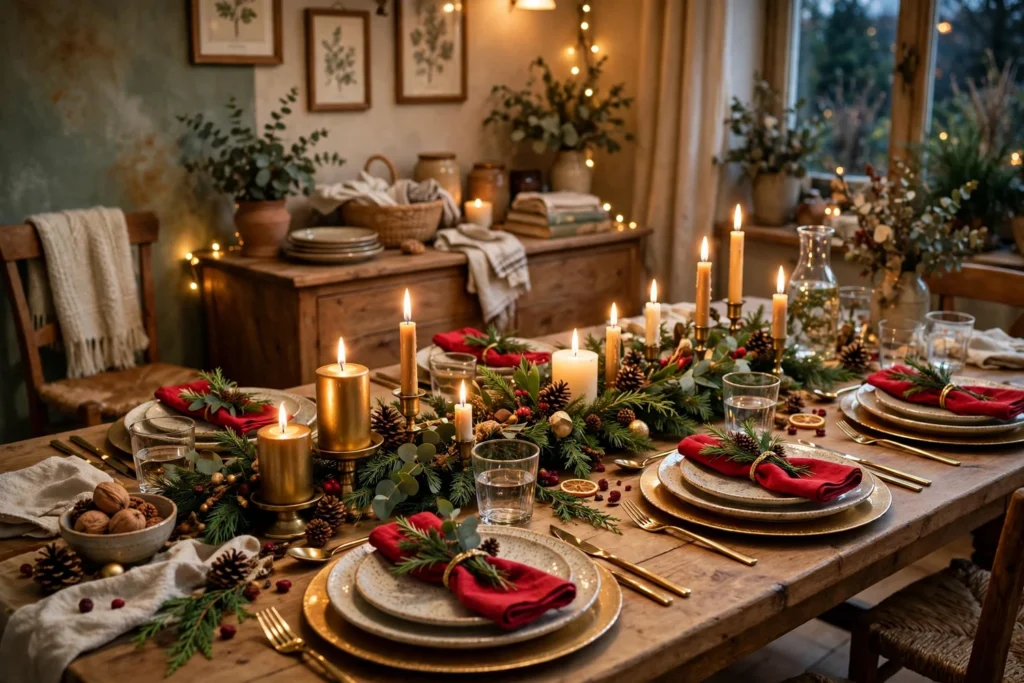
There is a particular kind of quiet that settles over a house just before a Christmas meal, when the table is already set and the food is still in the kitchen. The plates are waiting, the glasses catch the light, and the room smells faintly of pine and something sweet from the oven. That moment is worth planning for, because a well-dressed table does more than look pretty in a photograph. It tells everyone who sits down that they are welcome, that this meal matters, and that someone took the time to make an ordinary evening feel like an occasion.
You do not need a cupboard full of matching china or a florist on speed dial to get there. Most of the loveliest Christmas tables are built from a few honest ingredients: a cloth you actually like, a centerpiece that leaves room for the dishes, candlelight at a height where nobody has to peer around it, and one or two details that feel personal rather than bought in a set. The trick is to choose a direction first, then let every other decision follow it, so the table reads as one thoughtful whole instead of a collection of nice things that happen to be in the same room.
The twelve looks below cover the full range of Christmas moods, from candlelit formality to a relaxed farmhouse supper, and each one is written so you can adapt it to the table you already own. Some use pieces you probably have — plain white plates, a handful of jars, a length of ribbon — while others are worth a small, deliberate purchase that you will reuse year after year. Pick the one that sounds like your house at Christmas, borrow the details that suit you, and leave the rest. The best table is the one you can actually sit down at and enjoy.
Table of Contents
- 1. Classic Red and Gold Candlelit Elegance
- 2. Winter Woodland Evergreen Retreat
- 3. Frosted Silver and Ice Blue Sparkle
- 4. Rustic Farmhouse Plaid and Pine
- 5. Elegant Ivory and Champagne Glow
- 6. Nordic Minimal White and Pale Pine
- 7. Berry and Burgundy Velvet Richness
- 8. Copper and Amber Candlelight Warmth
- 9. Coastal Navy and Driftwood Calm
- 10. Vintage Rose and Sage Softness
- 11. Midnight Navy and Gold Starlight
- 12. Cranberry and Forest Tartan Tradition
- Frequently Asked Questions
1. Classic Red and Gold Candlelit Elegance
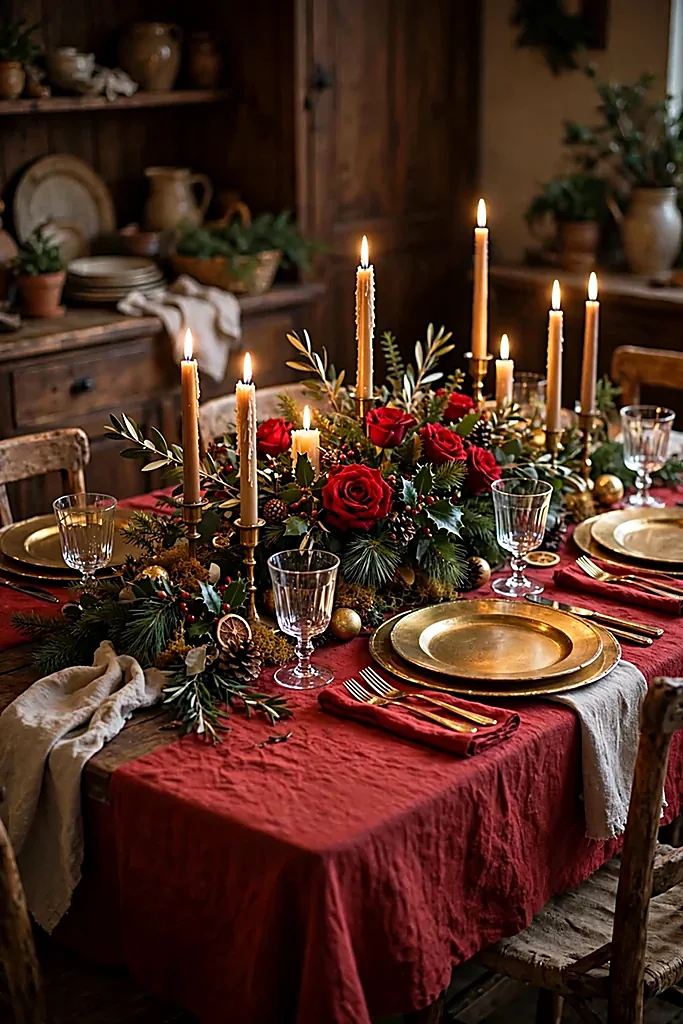
Classic Red and Gold Candlelit Elegance
Start with a deep red tablecloth or a runner in a rich, true red laid over a cream cloth, so the color reads warm rather than loud. White or ivory plates keep the setting crisp, and gold-rimmed glasses or a slim gold charger under each plate add the gleam without tipping into glitter. Fold the napkins simply — a plain fold with a sprig of fresh greenery tucked into the ring, or a single gold ribbon tied around a rolled napkin — so the table feels dressed but not fussy. Down the center, run a low garland of fresh fir or cedar, and nestle pillar candles of different heights into it, with a few gold baubles scattered between the branches rather than hung above them. Keep everything low enough that guests can see each other across the table; tall candlesticks belong at the ends or on a sideboard, not in the middle of the conversation. If you use taper candles, choose unscented ones so they do not compete with the food, and set them in sturdy holders that will not wobble when someone reaches for the bread.
For place settings, a handwritten name card on cream card, propped against the glass or slipped under the napkin fold, adds a finishing touch that costs almost nothing and makes everyone feel expected. A small bunch of red berries or a single rose at each place is lovely but optional; the candlelight and the garland already do most of the work. Finish with a scattering of gold confetti stars only if your table is large — on a small table, restraint reads as elegance.
For more table inspiration beyond Christmas, browse these friendsgiving table settings — most of the layering tricks work for any gathering.
Candlelight Checklist for a Red and Gold Table
- Place candles low and in the center so faces stay visible across the table.
- Mix pillar heights for depth, but keep flames clear of garland and napkins.
- Use unscented candles at the table so aromas stay with the food.
- Light candles last, just before guests sit down, for the full effect.
2. Winter Woodland Evergreen Retreat
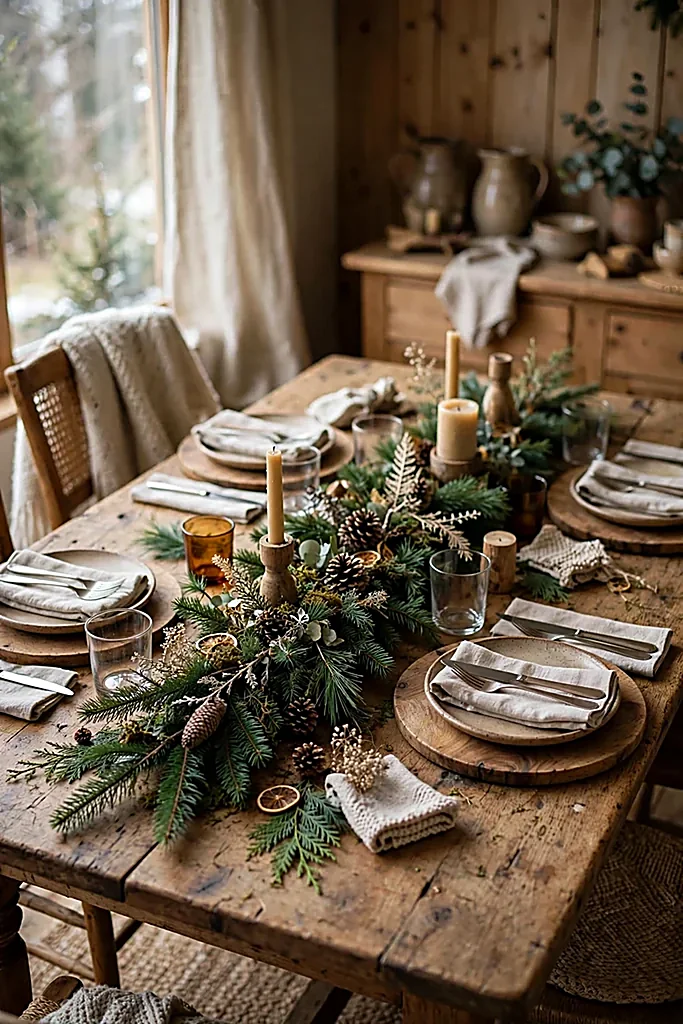
Winter Woodland Evergreen Retreat
This look brings the feeling of a walk through snow-dusted woods indoors, and it leans on texture more than color. Begin with a natural linen cloth in oatmeal or undyed cotton, or leave a wooden table bare with a simple burlap or linen runner down the middle.
The wood itself becomes part of the decoration, so a bare table is not a shortcut here — it is the point. Plates in cream, stoneware, or soft sage keep the palette quiet, and wooden chargers or woven placemats add warmth under each setting.
The centerpiece should feel gathered rather than arranged: a long, loose trail of fir branches, pinecones, and a few bare twigs, with small wooden ornaments or dried orange slices tucked in. Add clusters of candles in glass hurricanes so the flame is sheltered and the light pools softly over the greenery. Avoid anything shiny or brightly colored; the beauty of this table is in its restraint, in moss greens, bark browns, and the soft cream of candlelight.
At each place, tie the napkin with twine and slip in a tiny pinecone or a sprig of rosemary, which doubles as a fragrant favor guests can take home. Mismatched wooden-handled cutlery or simple pewter-toned flatware suits the mood better than polished silver. Keep the rest of the room dim, let the candles do the talking, and the table will feel like a clearing in the woods — calm, grounding, and quietly festive.
A woodland table begs for a board down its middle — build one from these thanksgiving charcuterie board ideas and let guests graze between courses.
Gathering Your Woodland Greenery
Gathering:
- Cut fir, cedar, and pine branches a day ahead and keep them in a cool spot so they stay fresh.
- Choose pinecones in two sizes for a natural, uneven look rather than a uniform row.
Finishing touches:
- Tuck dried orange slices into the garland for a hint of color that still feels woodland.
- Shake branches outdoors before bringing them in to avoid needles on the tablecloth.
3. Frosted Silver and Ice Blue Sparkle
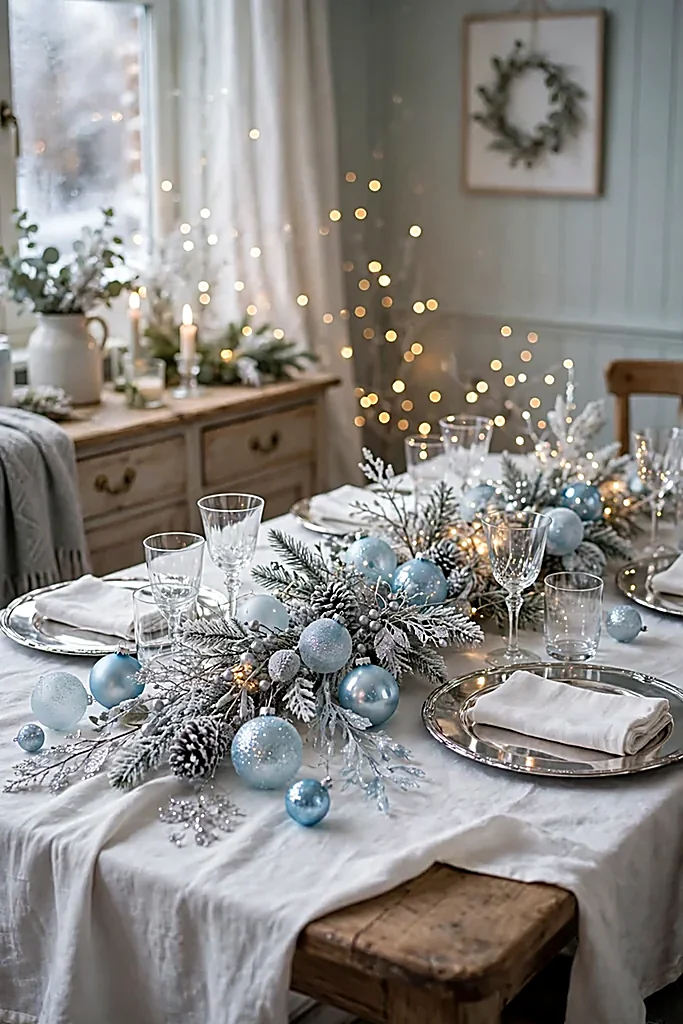
Frosted Silver and Ice Blue Sparkle
Think of a winter morning after a frost: pale, bright, and cool, with light bouncing off every surface.
Start with a white or very pale blue cloth, and layer a sheer silver or icy-blue runner over it for a subtle shimmer. Clear glass plates or white plates with a silver rim keep the setting airy, and silver cutlery with simple, modern lines suits the mood better than ornate gold. Napkins in white or ice blue, folded crisply, add structure without weight.
The centerpiece should sparkle without glittering aggressively: a bed of frosted branches, silver-painted pinecones, or a few glass ornaments in pale blue and clear glass arranged along the center, interspersed with white pillar candles. A string of tiny white fairy lights woven loosely through the branches gives a frosty glow after dark, but keep the wire hidden under the greenery so the light looks like it comes from nowhere. Avoid red entirely here; even a single red accent will pull the eye away from the cool palette. Place settings can carry the theme gently: a silver napkin ring, a small frosted ornament tied to each napkin with silver thread, or a place card written in silver ink on white card. Clear glassware, including water glasses with a slight blue tint if you have them, completes the icy feel. This is a look that photographs beautifully and feels especially right for a Christmas lunch, when daylight can play across the silver and glass.
Start the evening beside this sparkling table with a few bites from these thanksgiving appetizers — the make-ahead timing keeps you out of the kitchen.
Keeping the Frosted Look Frosty, Not Gaudy
Stick to three tones only: white, ice blue, and silver. Use matte frosted finishes alongside one or two shiny pieces so the table does not glare, and hide fairy-light wires under branches and cloth folds. Skip red, green, and gold entirely in this scheme — one stray color breaks the frost.
4. Rustic Farmhouse Plaid and Pine
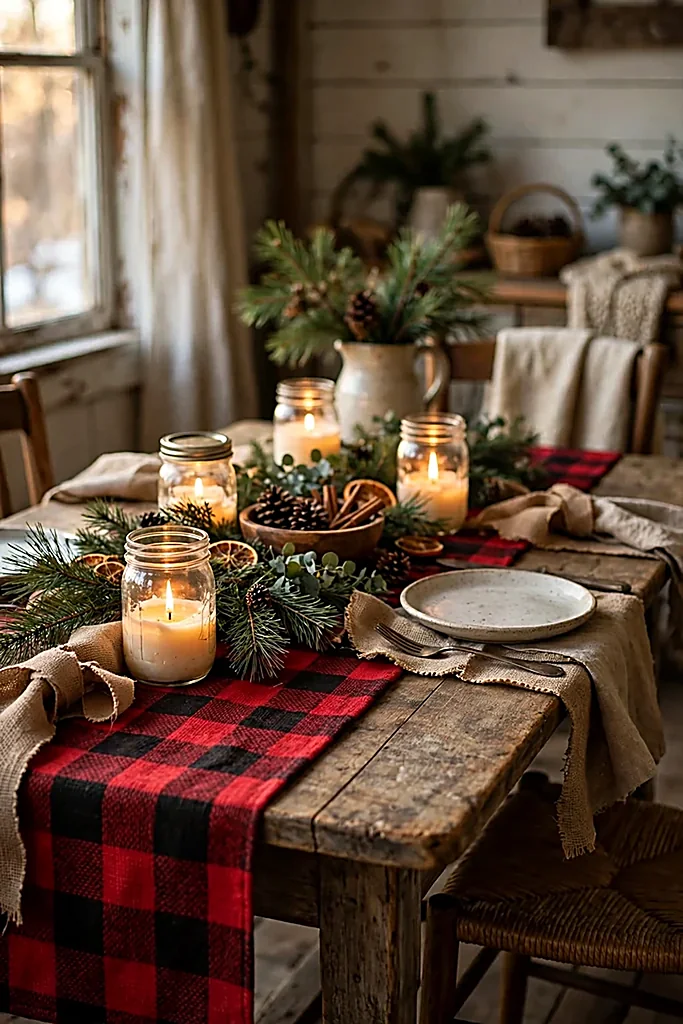
Rustic Farmhouse Plaid and Pine
A farmhouse Christmas table should feel like it grew out of the kitchen rather than out of a shop window, and plaid is the quickest way to get there. Lay a red and green or red and cream plaid cloth, or use a plain cream cloth with a wide plaid runner and matching napkins.
Everyday stoneware or cream plates suit the look perfectly — this is not the occasion for your most formal china — and wooden chargers or woven placemats ground each setting. Tie napkins with a simple plaid ribbon or a length of twine.
For the centerpiece, a wooden box, a low basket, or a simple tray filled with pine branches, pinecones, and a few red berries makes a generous, unfussy display. Add chunky pillar candles in mason jars or simple glass cylinders, and a few plaid bows tied onto the jar necks if you like the extra touch. Keep the arrangement low and a little wild, as though the branches were cut that morning, and leave plenty of room at the ends of the table for serving dishes — a farmhouse table is a working table, and it should not feel like a display case.
Red gingham or plaid napkins, a handwritten place card on brown kraft card, and a small candy cane or sprig of holly at each place finish the look without any fuss. If children are eating at the table, this is a forgiving scheme: a spill on plaid barely shows, and nothing on the table is too precious to be near small hands.
If you love how this plaid-and-pine feeling carries from the front door inward, the same rustic spirit works beautifully from the entryway to the dining room — carry the plaid runner, pine branches, and warm wood tones from your hallway into this table setting so the whole house feels connected these hallway table decor ideas.
Farmhouse Table Shopping List
- Plaid cloth or runner plus matching napkins — one pattern, repeated, is enough.
- Wooden box, tray, or basket for the centerpiece base.
- Pine branches, pinecones, and red berries — fresh beats faux here.
Add chunky pillar candles in glass jars for safe, steady light, plus kraft card and twine for handwritten place cards.
5. Elegant Ivory and Champagne Glow
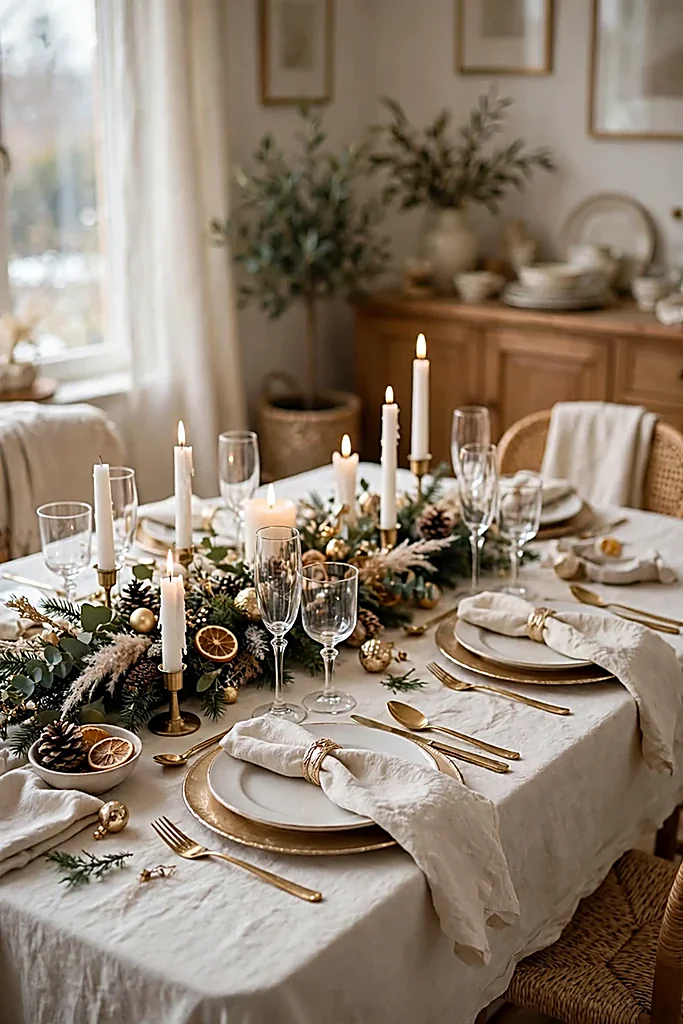
Elegant Ivory and Champagne Glow
Ivory and champagne is the quietest luxury on this list, and it works by layering soft, warm neutrals until the table glows. Start with an ivory or champagne cloth, ideally one with a subtle texture — a damask weave, a fine linen slub, or a soft jacquard — because texture is what keeps an all-neutral table from looking flat. Ivory or cream plates, gold or champagne-toned cutlery, and glasses with a delicate gold rim carry the warmth through each setting. Napkins in ivory, folded in a simple pocket fold, hold the cutlery neatly and look effortlessly polished.
The centerpiece should be low, lush, and pale: cream roses or white ranunculus mixed with soft greenery, a few champagne-colored ornaments, and candles in gold or glass holders at varying heights. A thin garland of eucalyptus or olive branches down the center adds a silvery-green note that keeps the palette from turning yellow. Keep the flowers fresh and the arrangement loose — tight, formal bouquets can make an ivory table feel stiff, while a relaxed, garden-gathered arrangement feels inviting. Candlelight is essential here, because champagne tones come alive in warm light and can look washed out under bright overhead lighting. Dim the room lights, rely on candles and perhaps a low lamp nearby, and the whole table will seem to glow from within. Place cards in a soft gold script on ivory card complete the setting, and a single cream rose or a sprig of dried gypsophila at each place is a gentle final touch.
A table this dressed up deserves an entrance to match — peek at these velvet gowns after 70 for the same rich holiday mood.
Ivory and Champagne Palette at a Glance
| Element | Color / Material | Why it works |
|---|---|---|
| Plates | Ivory or cream china | Keeps the palette calm and unified |
| Cutlery and glassware | Gold or champagne tones, gold-rimmed glasses | Adds warmth without bright metallic contrast |
| Centerpiece | Cream roses, eucalyptus, champagne ornaments | Lush but pale, so the table stays airy |
| Lighting | Pillar and taper candles in gold or glass holders | Warm glow that makes neutrals luminous |
6. Nordic Minimal White and Pale Pine
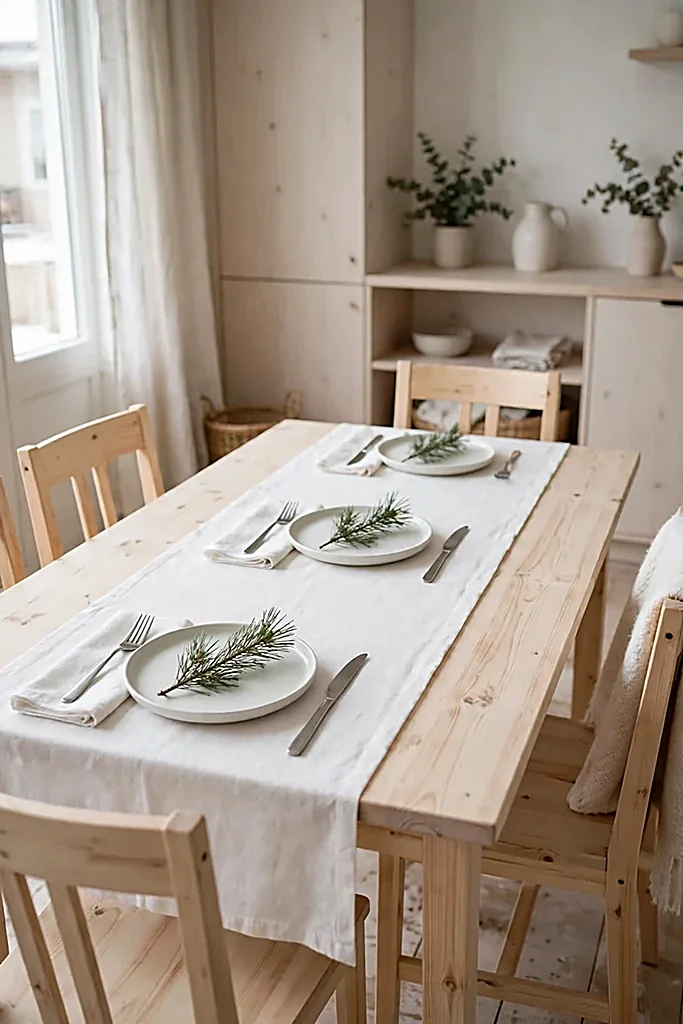
Nordic Minimal White and Pale Pine
Nordic styling is about what you leave out as much as what you put in, and this table proves that a few well-chosen pieces can feel more festive than a crowded one.
Use a plain white or undyed linen cloth, or a bare pale-wood table with a single narrow white runner. White plates, simple light-wood or matte-white placemats, and plain cutlery keep the setting clean. Napkins in white linen, folded in a single straight fold, are all the decoration a place setting needs — perhaps with one small sprig of pale pine laid across the top.
The centerpiece is deliberately spare: a single long branch of pale pine or fir laid down the middle, a few white candles in simple holders, and perhaps three or four plain wooden or white ornaments spaced widely apart. Resist the urge to fill every gap; the empty space between objects is part of the design, and it lets the eye rest. A small bowl of pale pinecones or a single white star ornament at each end of the table can anchor the arrangement without cluttering it. This look suits smaller gatherings and quieter Christmases, where conversation matters more than spectacle, and it pairs beautifully with a simple meal served family-style. Keep the room light and uncluttered, use daylight or soft white candles rather than warm yellow light, and let the pale pine scent carry the season. If you usually over-decorate, this is a good exercise in restraint — and you may find you prefer it.
Handmade touches suit the Nordic mood — a small piece from these crochet patterns for beginners under a candle or vase keeps it personal.
The Nordic Rule of Three
- Pick three materials only: white linen, pale pine, and light wood.
- Limit the centerpiece to three kinds of object: branches, candles, and one ornament type.
- Leave at least a hand’s width of empty table between each decorative group.
- When in doubt, take one thing away before adding anything new.
7. Berry and Burgundy Velvet Richness
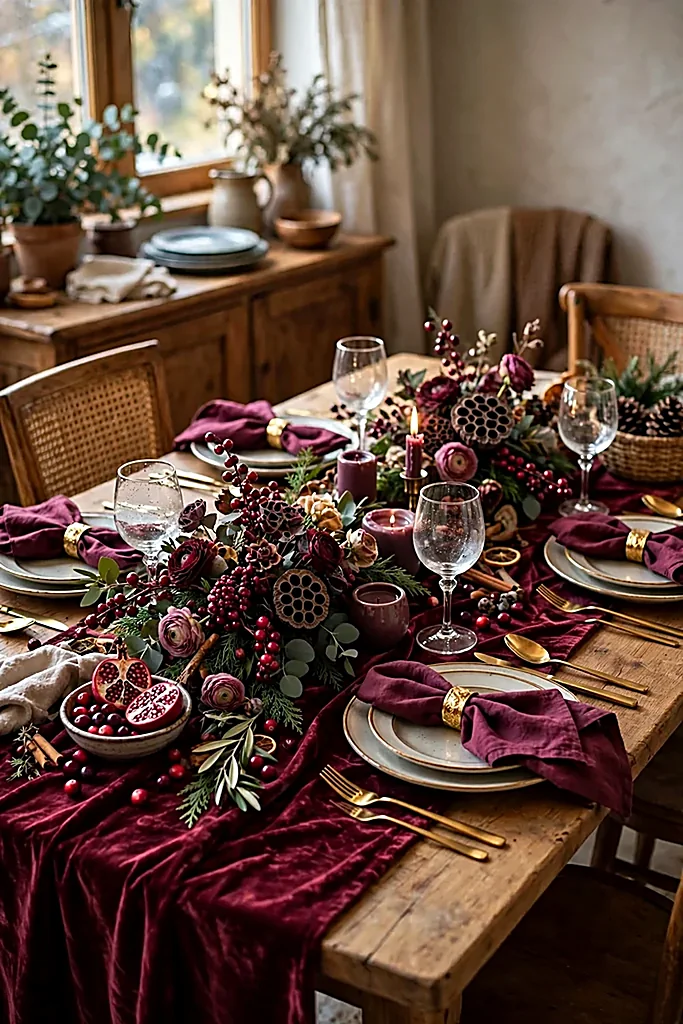
Berry and Burgundy Velvet Richness
Burgundy and berry tones bring a deep, jewel-like warmth that suits evening meals and longer, slower celebrations. Begin with a burgundy or deep wine-colored cloth, or a cream cloth with a wide burgundy velvet runner — velvet is the key texture here, and even a narrow runner in velvet changes the whole feel of the table. Plates in cream or soft gold keep the setting from going too dark, and gold or brass cutlery echoes the richness without competing. Napkins in burgundy velvet or a deep red linen, tied with gold cord, add a tactile luxury.
The centerpiece should be abundant: dark red roses or dahlias, deep berries, burgundy ornaments, and dark greenery, arranged low and full, with gold or brass candle holders rising just above the flowers. A few sprigs of dark foliage, like magnolia leaves or deep green fir, give the arrangement depth and keep the reds from blending into one flat mass.
Add a scattering of gold beads or small gold ornaments between the flowers for points of light.
Place settings can be generous too: a gold charger, a burgundy napkin, a place card in gold ink on deep red card, and perhaps a single dark rose or a cluster of berries laid across the napkin. This is a look that welcomes candlelight and low room lighting, so dim the overheads and let the gold and burgundy glow. It is also forgiving of a rich, hearty menu — the table looks as indulgent as the food tastes.
Serve dessert right on the velvet-toned runner — these pecan pie cake recipes bring the same deep, spiced richness.
Balancing Deep Burgundy So It Stays Rich, Not Heavy
Setting the scene:
- Anchor dark tones with cream plates and gold accents so the table does not go gloomy.
- Keep the centerpiece low and full rather than tall and sparse.
Depth and light:
- Use dark greenery for depth, not just more red flowers.
- Dim overhead lights and let candles warm the burgundy tones.
8. Copper and Amber Candlelight Warmth
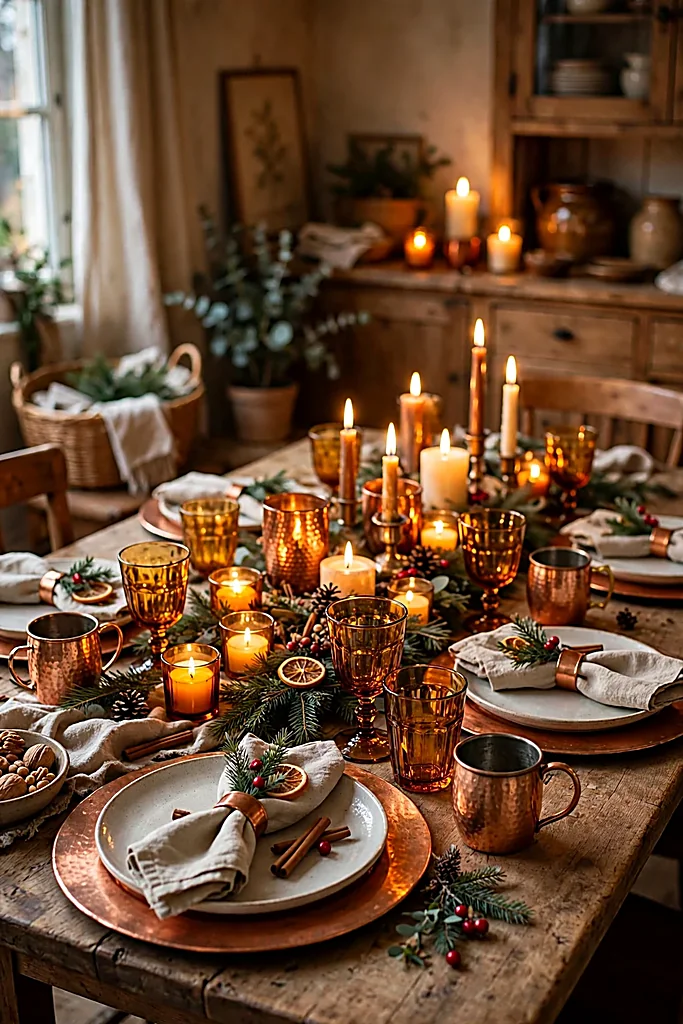
Copper and Amber Candlelight Warmth
Copper is the friendliest metal at a Christmas table — warmer than silver, softer than gold — and paired with amber it creates a glow that feels like late afternoon sun.
Start with a warm neutral cloth in cream, oatmeal, or soft terracotta, and add a copper-toned runner or copper chargers under each plate. Cream or warm white plates, copper or rose-gold cutlery if you have it, and amber-tinted glasses or simple clear glasses with a copper rim carry the palette through. Napkins in rust, terracotta, or warm mustard, folded simply, add color without shouting.
The centerpiece is built around candlelight in copper and glass: copper lanterns, copper candle holders, or amber glass hurricanes holding pillar candles, interspersed with dried orange slices, cinnamon sticks, and a few sprigs of fir or eucalyptus. The dried oranges are the secret ingredient — they catch the candlelight and glow amber from within, and they smell wonderful. Keep the arrangement clustered in the center rather than spread thin, so the light pools in one warm island in the middle of the table. At each place, a copper napkin ring or a length of copper ribbon tied around the napkin, plus a small dried orange slice or cinnamon stick tucked into the fold, ties the setting to the centerpiece. This look is especially lovely for a late lunch that runs into the evening, when the copper and amber tones deepen as the daylight fades and the candles take over.
For a centerpiece with a handmade touch, try tucking a few small snow globes among the copper lanterns and dried oranges — they catch the candlelight beautifully and give guests something delightful to look at between courses these DIY Christmas snow globes.
Candle Safety Note for Copper and Amber Tables
Never place candles directly against dried oranges, cinnamon sticks, or greenery. Use glass hurricanes or lanterns for any candle near dried or flammable decorations, and keep flames at least a hand’s width from napkins, ribbons, and place cards. Extinguish candles before leaving the table, even for a short break between courses.
9. Coastal Navy and Driftwood Calm
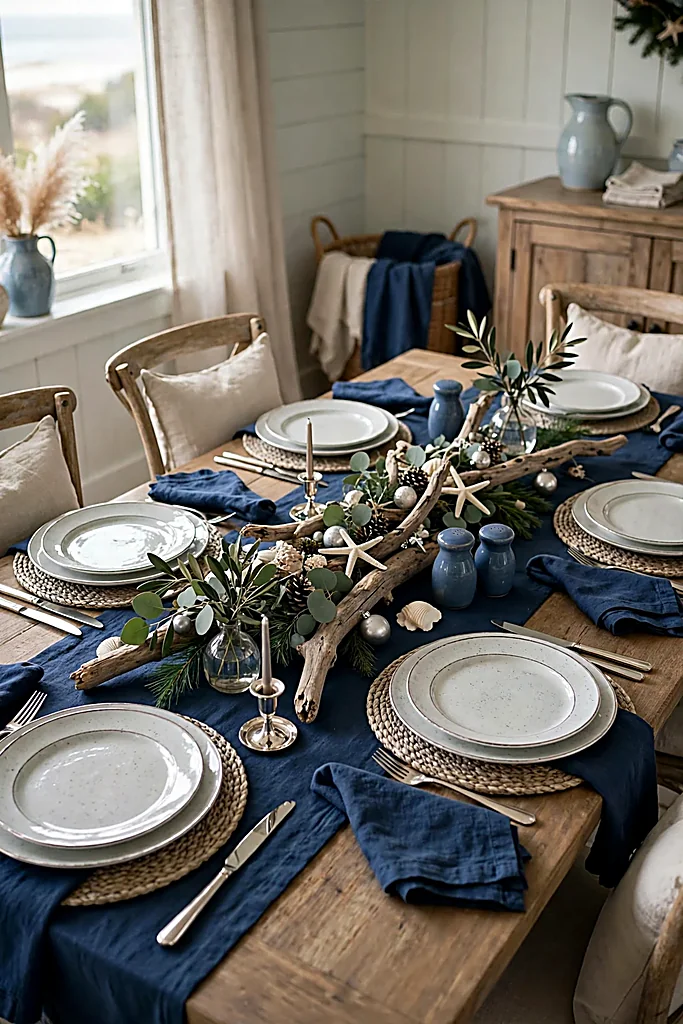
Coastal Navy and Driftwood Calm
A coastal Christmas table trades traditional red and green for the quiet palette of the sea in winter: deep navy, soft white, pale sand, and weathered wood. Begin with a white or pale sand cloth, and layer a navy runner down the center for a strong, calm stripe of color. White plates, navy napkins, and simple silver or driftwood-toned chargers keep the setting clean. Rope or jute napkin rings, or napkins tied with natural twine, nod to the seaside without turning the table into a beach theme.
The centerpiece should feel like something found on a winter shore: a piece of driftwood or a long, low wooden tray holding white candles, a few pale shells or sea stars, sprigs of fir or eucalyptus, and perhaps a handful of silver or white ornaments. Keep it low and horizontal, echoing the line of the horizon, and avoid anything brightly colored. A string of small white lights woven through the greenery adds a frosty sparkle after dark, but keep it subtle — this table is about calm, not glitter. Place settings stay simple: a white plate, a navy napkin, a handwritten place card in navy ink on white card, and perhaps a single small shell or a sprig of greenery at each place. This look suits houses near the coast, of course, but it also works beautifully anywhere you want a Christmas table that feels fresh, modern, and uncluttered — a reminder that the season can be peaceful as well as festive.
Comfort food belongs on a calm table too — a bubbling dish from these mac and cheese recipes looks right at home here.
Budget Swaps for a Coastal Table
- Use a navy runner over a plain white cloth you already own instead of buying a new cloth.
- Swap shop-bought driftwood for a weathered wooden board or tray from the kitchen.
Collect shells and pebbles on a walk instead of buying coastal decorations, and tie napkins with kitchen twine rather than buying rope rings — the effect is the same.
10. Vintage Rose and Sage Softness
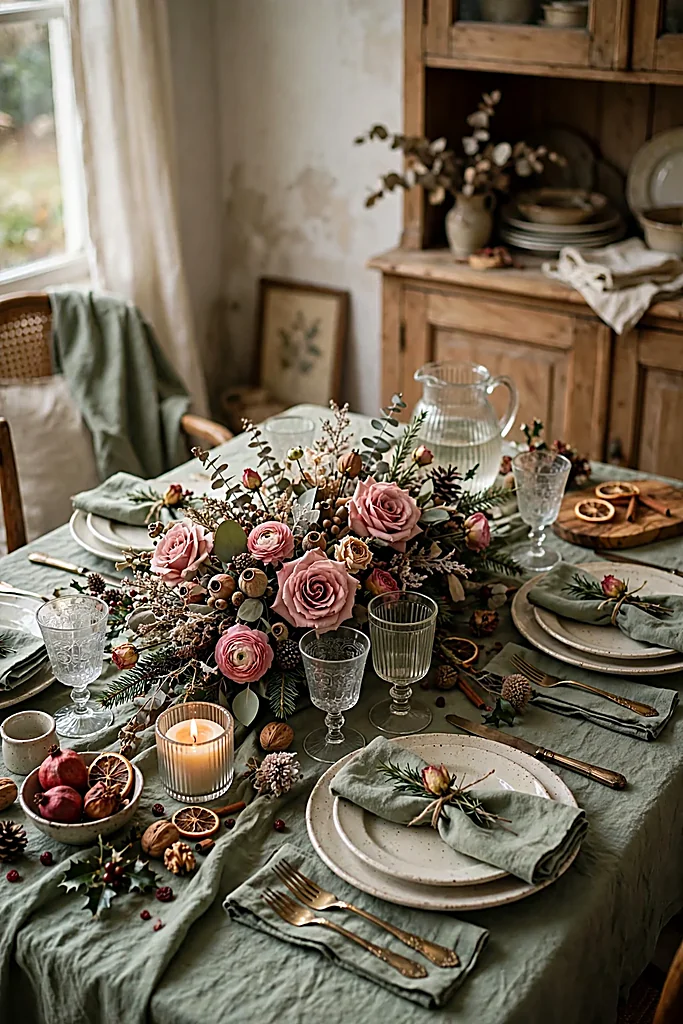
Vintage Rose and Sage Softness
Vintage rose and sage is a gentle, romantic palette that feels like a Christmas remembered from childhood — soft, slightly faded, and full of charm. Start with a cream or pale sage cloth, perhaps one with a subtle floral pattern if you have a vintage tablecloth tucked away.
Plates in cream, pale pink, or soft sage — mismatched vintage plates actually suit this look better than a matching set — and silver or pewter cutlery keep the setting delicate. Napkins in pale pink or sage linen, tied with a thin silk ribbon, add a soft touch.
The centerpiece should be a loose, garden-style arrangement: pale pink roses, ranunculus, or carnations mixed with sage-green eucalyptus and dusty miller, arranged in a vintage bowl, a milk jug, or a collection of small glass jars down the center. Add pale pink and cream candles in mismatched vintage holders, and a few soft pink ornaments nestled among the flowers. The charm here is in the imperfection — slightly different heights, slightly different jars, flowers that look gathered rather than arranged.
At each place, a small posy of dried lavender or a single pale rose tied to the napkin, and a place card in soft script on cream card, complete the vintage feeling. This table pairs well with afternoon tea-style elements — a cake stand of biscuits, a pot of tea alongside the meal — and it suits a Christmas gathering that leans more toward conversation and lingering than toward formality.
Finish the meal with something homey — these apple pie biscuits echo the soft, nostalgic feel of this setting.
Vintage Rose and Sage — What to Use Where
| Area of the table | Vintage rose and sage choice |
|---|---|
| Plates | Cream, pale pink, or sage — mismatched vintage sets welcome |
| Napkins | Pale pink or sage linen, tied with thin silk ribbon |
| Centerpiece | Pale pink roses, eucalyptus, dusty miller in jars or a vintage bowl |
| Candles | Pale pink and cream candles in mismatched vintage holders |
| Place detail | Single pale rose or dried lavender tied to the napkin |
11. Midnight Navy and Gold Starlight
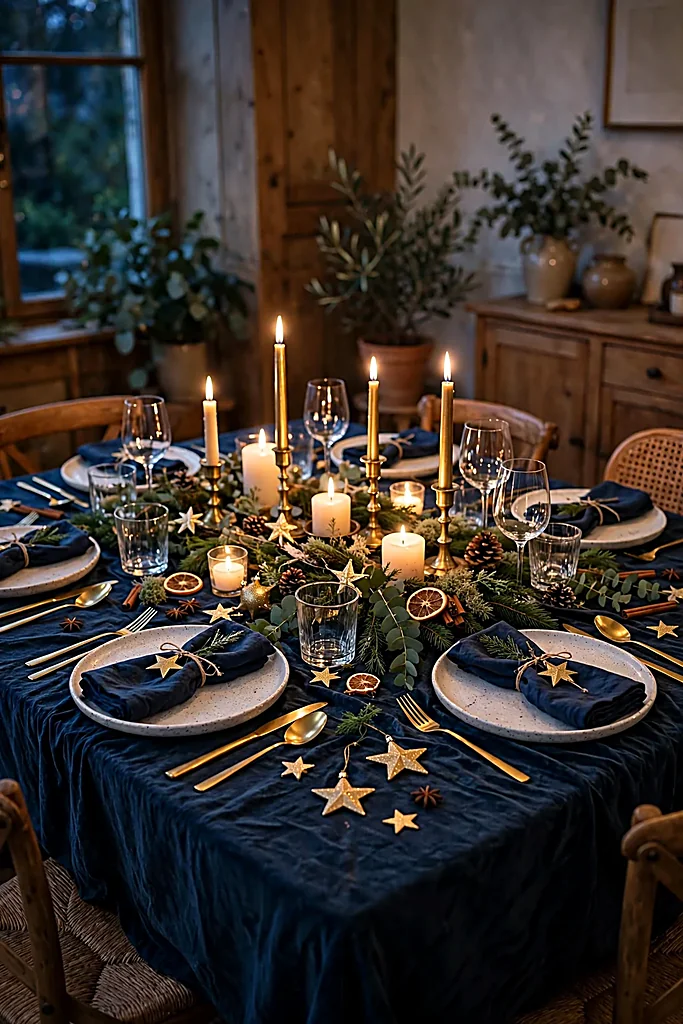
Midnight Navy and Gold Starlight
Midnight navy and gold is the most dramatic look on this list, made for a Christmas dinner after dark when the room can be lit almost entirely by candlelight. Begin with a deep navy cloth — a rich, dark navy, not a bright blue — so the table itself feels like the night sky. Gold chargers under white or cream plates create a striking contrast, and gold cutlery or gold-rimmed glasses carry the starlight theme through each setting. Napkins in navy or gold, folded crisply, add structure; a gold napkin ring or a length of gold ribbon ties them neatly.
The centerpiece should sparkle like a clear winter night: gold star ornaments, gold baubles, and small gold candle holders scattered along a bed of dark greenery, with tall gold taper candles at intervals for height. A scattering of gold star confetti or a few gold-painted pinecones adds to the celestial feel.
Keep the greenery dark and the gold bright — the contrast is what makes this table dramatic — and let the candlelight reflect off every gold surface. Place cards in gold ink on navy card, a small gold star ornament at each place, and perhaps a gold-wrapped chocolate or a tiny star-shaped biscuit as a favor complete the look. Dim the room lights as low as you dare, rely on candles and fairy lights, and the table will feel like dinner under the stars — festive, a little magical, and perfect for the main Christmas meal itself.
Leave a little sweet bowl on the table for lingering guests — these peanut butter chocolate crunch balls disappear fast.
Making Midnight Navy Work in a Small Room
- Keep the navy to the cloth and napkins only — white plates stop the table going dark.
- Use plenty of gold and candlelight to lift the scheme; navy needs light to shine.
- Add a mirror or a glass tray under the centerpiece to bounce candlelight around.
- Skip navy walls or dark curtains in the same room if you can — let the table be the night sky.
12. Cranberry and Forest Tartan Tradition
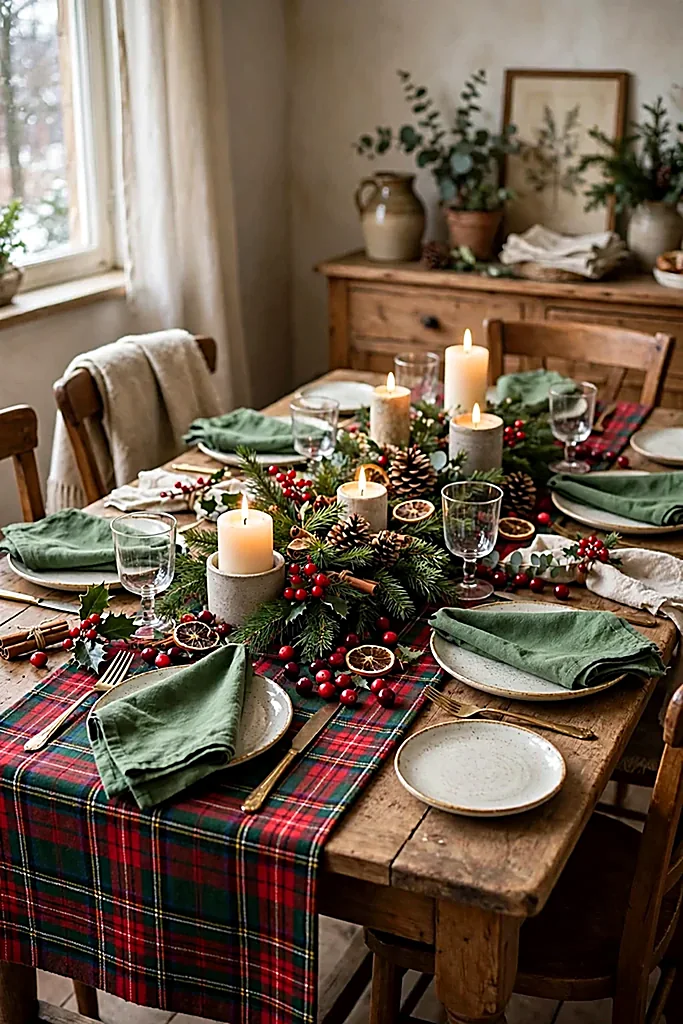
Cranberry and Forest Tartan Tradition
Tartan brings an instant sense of heritage and warmth, and cranberry paired with deep forest green is the most classic Christmas combination of all.
Lay a tartan cloth in cranberry, green, and cream, or use a plain cream cloth with a wide tartan runner and matching napkins for a slightly lighter effect. Cream or white plates, simple silver or pewter cutlery, and clear glasses keep the setting grounded — the tartan is the star, and everything else should let it shine. Napkins in the same tartan, or in solid cranberry, folded simply, tie the table together.
The centerpiece should be generous and traditional: a long garland of forest greenery — fir, pine, and holly — studded with cranberries, red berries, and a few tartan bows, with cream or red pillar candles nestled into the greenery. A wooden bowl of cranberries or a small stack of tartan-wrapped parcels down the center adds to the festive abundance. Keep the arrangement low and full, and leave room for the serving dishes, because a tartan table is meant for a feast.
At each place, a sprig of holly or a small cluster of cranberries tied to the napkin, and a place card on cream card with a tartan border if you can manage it, add a traditional finishing touch. This is a look that suits a large family gathering, a long table, and a meal with all the trimmings — it feels like Christmas as it has always been, and that familiarity is part of its charm.
Once the tartan table is set, echo the same traditional feeling around the rest of the room with a few vintage pieces — an old brass candlestick, a worn wooden bowl, or a framed family photograph — so the table feels part of a home with history, not just a decorated surface these vintage home decor ideas.
Tartan Without the Clash
Pattern discipline:
- Use one tartan pattern only — mixing two tartans on one table looks busy fast.
- Pair tartan with solid cream or white plates, never patterned china.
Where tartan belongs:
- Repeat the tartan in just two places: cloth or runner, plus napkins.
- Keep other decorations simple — greenery and berries, not competing patterns.
Frequently Asked Questions
Set It, Light It, and Enjoy It
Whichever of these twelve tables sounds most like your house, remember that the table itself is only the setting for the meal — and the meal is only the setting for the people around it. Choose the look that makes you smile when you picture it, set it the day before if you can, light the candles last, and then sit down and enjoy it. A Christmas table does not need to be perfect to be magical. It needs to be warm, welcoming, and full of the people you love, with candlelight, good food, and a little greenery in between. Merry Christmas, and may your table be as joyful as the gathering around it.
More from The Glossy Guide
 Home Decor
11 Christmas Decor Ideas That Make the Whole House Feel Festive
There is a moment in early December when a house starts to feel like Christmas, and it rarely comes from…
 Home Decor
14 Christmas Decorations That Turn Your Whole Home Into a Holiday Haven
There is a moment every December when the house finally starts to feel like Christmas, and it rarely comes from…
 Food
13 Friendsgiving Table Settings That Make Everyone Feel Welcome
Friendsgiving has a different feeling from a family holiday dinner. Nobody is keeping score, nobody is guarding a seating chart…