12 Flocked Tree Decorating Ideas That Make a Snow-Dusted Tree Feel Magical
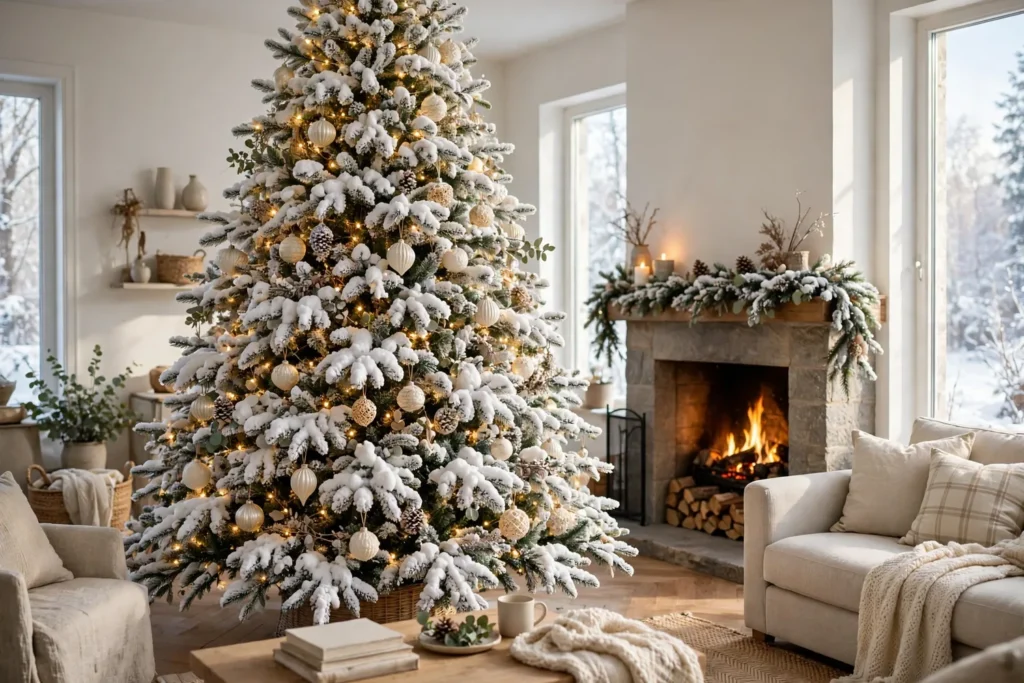
Flocked tree decorating ideas change the whole decorating equation. A flocked tree’s branches are already white, already soft, already snowy, so every ornament sits against a pale backdrop instead of disappearing into dark green. That is the gift of flocking, and also its challenge: colours that looked rich on a green tree can wash out here, lights behave differently on a frosted surface, and a garland that wrapped neatly around bare branches may sink into the flock and vanish. Once you understand how flocking works with light and colour, though, decorating becomes easier, not harder, because the tree itself does half the work for you.
The first rule is to let the flocking breathe. A lightly flocked tree still shows green between the frost, so it takes colour much like a traditional tree, only softer. A heavily flocked tree is almost entirely white, which means you need deeper, warmer, or more saturated ornaments to keep the tree from looking pale and flat, and you need to place lights deep inside the branches rather than draping them only on the tips, where the flocking scatters and dulls the glow. Warm white lights are almost always the safer choice on flocked branches, because cool white can turn the whole tree icy blue, while warm white makes the snow look sunlit.
The twelve ideas below are all built around flocking itself, not just draped over it. Some lean into the snow with pale, frosty palettes, some set deep colour against the white for contrast, and some work with the practical side of a flocked tree, from keeping the flock from shedding to choosing a skirt that hides the stand without fighting the snow. Pick the density and mood that suits your room, borrow the light and ornament tricks that fit your tree, and let the snow do the rest.
Table of Contents
- 1. Lightly Flocked and Glowing in Warm Gold and Ivory
- 2. Heavily Flocked Woodland Tree with Pinecones and Burlap
- 3. A Blush Pink and Rose Gold Flocked Tree
- 4. Frosted Blue and Silver Winter Wonderland
- 5. Classic Red and Tartan on a Snowy Flocked Tree
- 6. A Slim Flocked Pencil Tree for Small Spaces
- 7. Champagne and Cream Elegance on Flocked Branches
- 8. Rustic Flocked Tree with Wooden Ornaments and Dried Orange Slices
- 9. Jewel Tones That Pop Against White Flocking
- 10. Vintage Mercury Glass and Soft Pastels on Flocking
- 11. Bold Black and White on a Flocked Tree
- 12. Copper and Terracotta Warmth on Snow-Dusted Branches
1. Lightly Flocked and Glowing in Warm Gold and Ivory
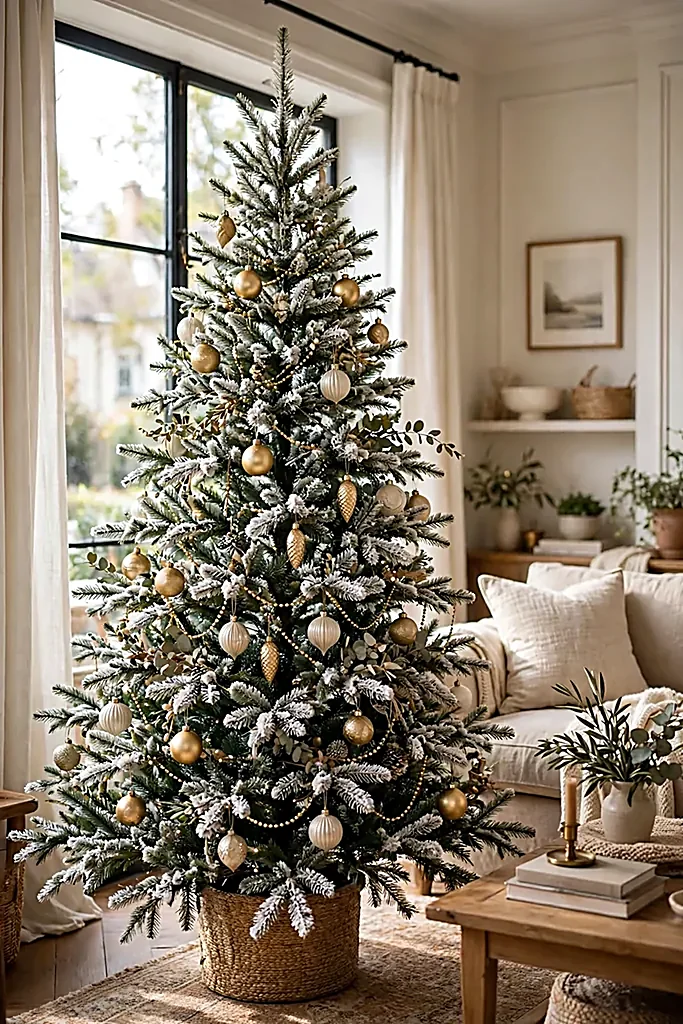
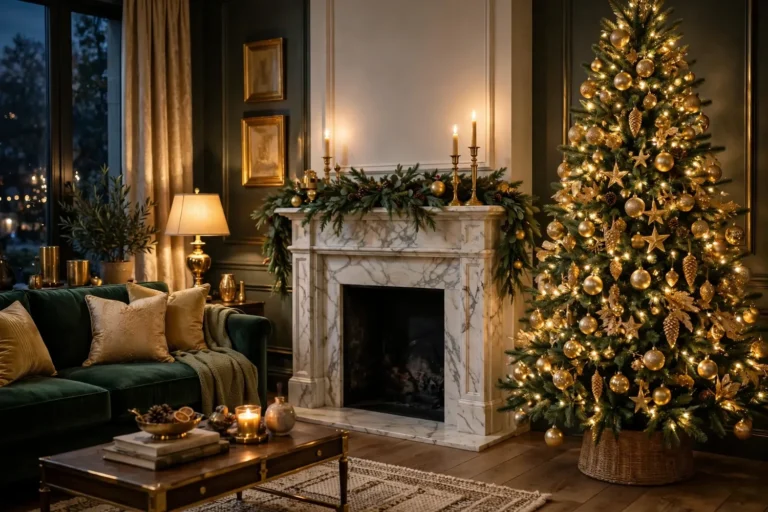
A lightly flocked tree is the gentlest place to start, because the green still shows through the frost and the tree reads as a snowy evergreen rather than a white sculpture. That in-between look is forgiving: gold and ivory ornaments glow against it without the washed-out effect you can get on a heavily flocked tree, and you do not need huge, saturated pieces to make an impact.
Choose gold in its warmer, softer forms, brushed gold, champagne gold, and antique gold, rather than bright mirror gold, which can look harsh next to pale flocking.
For lights, wind warm white strands deep into the branches, tucking the wire behind the frosted tips so the glow comes from inside the tree. On a light flocking, lights placed only on the outer tips tend to sit on top of the snow and look strung on, while lights nested deeper make the whole tree shimmer from within. Use one more strand than you would on a green tree of the same size, because the flocking absorbs a little of the light, and step back to check for dark patches before you hang a single ornament. Finish with a soft ivory tree skirt, a knitted or faux-fur one that echoes the snow without competing with it, and a gold ribbon garland draped in loose swags rather than tight spirals. A tight spiral cuts across the flocking and hides it, while loose swags let the frosted branch tips show between the folds. Place the tree where it catches daylight as well as lamplight, near a window but not hard against a radiator, so the gold reads warm by day and glowing by night.
A gold-and-ivory flocked tree anchors a classic room — these christmas decorations build the rest of the scheme around the same warmth.
Gold on Light Flocking: Getting the Glow Right
- Pick brushed, champagne, or antique gold over bright mirror gold next to pale flocking.
- Nest warm white lights deep inside the branches so the tree glows from within.
- Add one extra light strand compared with a green tree, since flocking softens the light.
- Drape ribbon in loose swags so frosted branch tips still show between folds.
2. Heavily Flocked Woodland Tree with Pinecones and Burlap
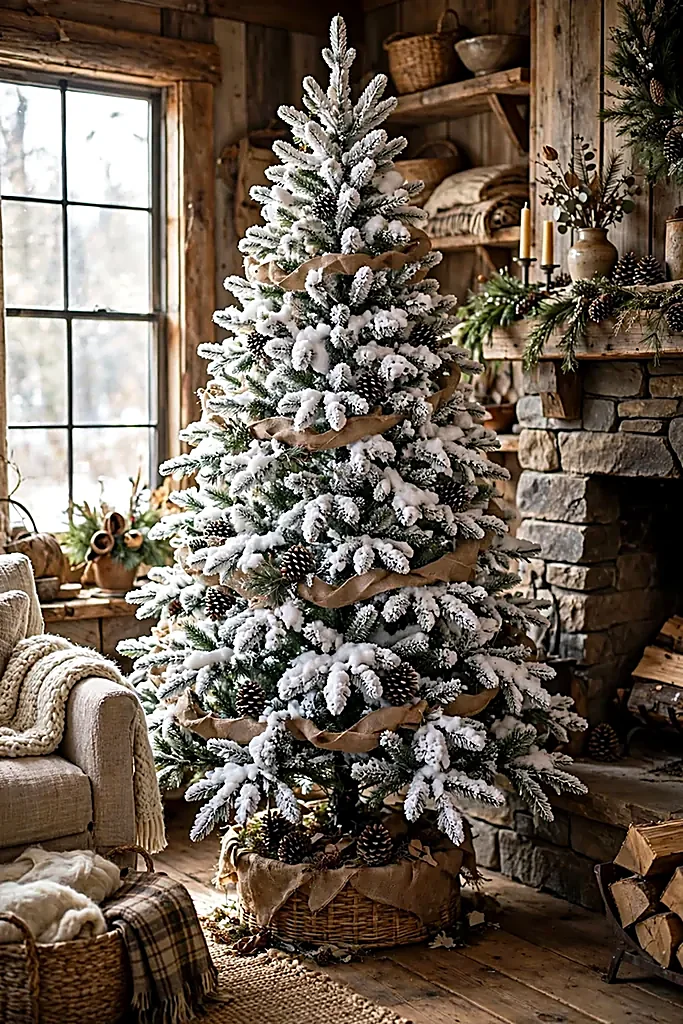
A heavily flocked tree is almost entirely white, which makes it the perfect partner for a woodland look, because natural textures stand out so clearly against the snow. Pinecones, burlap, twine, and wooden ornaments all read beautifully here, and the contrast between rough bark-brown materials and soft white flocking is what makes the tree feel like a forest after snowfall rather than a display piece. The key is scale: choose pinecones in two sizes and wooden ornaments large enough to hold their own, since small, fiddly pieces sink into heavy flocking and disappear.
Hang the heaviest pieces, the large pinecones and wooden stars, on the sturdier inner branches rather than the frosted tips, and wire them on instead of relying on hooks alone, because flocked tips are thicker and more slippery than bare branches. A burlap garland works better than a beaded one here: wrap it in wide, loose loops and let it settle into the branches, so it looks like it belongs in the snow rather than sitting on top of it. Avoid glittered pinecones if you want a natural woodland feel, since glitter fights the matte softness of the flocking. At the base, a burlap or woven basket collar suits this tree better than a shiny skirt, and a few extra pinecones and a bundle of cinnamon sticks tucked around the stand carry the woodland feeling to the floor. In the room, keep the rest of the decor simple, a plaid throw, a wooden bowl of pinecones, so the tree stays the focal point. Shake the tree gently outdoors or over a sheet before decorating, and vacuum the floor after, because heavy flocking sheds most when it is first handled each year.
Woodland trees invite woodland food — a board from these thanksgiving charcuterie board ideas on a burlap runner looks like it grew there.
Woodland on Heavy Flocking: Practical Notes
Scale and anchoring
- Use two pinecone sizes and larger wooden ornaments so pieces do not vanish into thick flocking.
- Wire heavy ornaments to inner branches; flocked tips are thick and slippery for hooks.
Garland and setup
- Choose wide, loose burlap loops over beaded garlands, which sink and disappear.
- Shake the tree over a sheet before decorating to catch the first-season shedding.
3. A Blush Pink and Rose Gold Flocked Tree
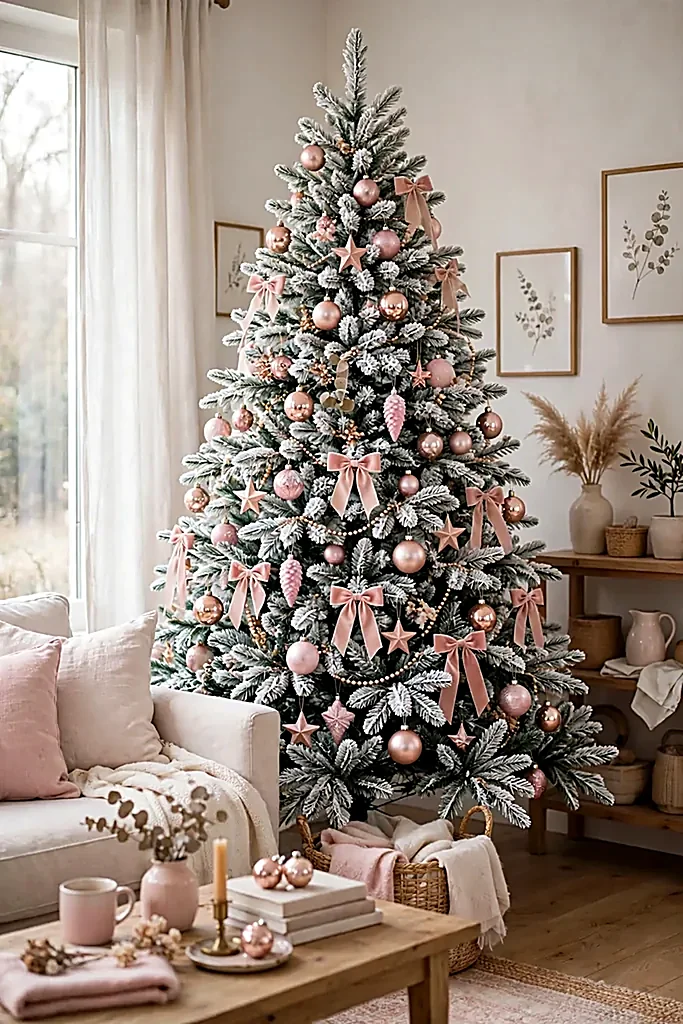
Blush pink on a flocked tree is softer than blush on green, because the white branches lift the pink and keep it from looking sugary. The trick is to choose blush in a range of depths, pale pink glass balls, a few deeper rose ornaments, and rose gold accents to warm the whole palette, so the tree has dimension instead of one flat shade of pink. Rose gold is especially useful here: against white flocking it reads as a warm metallic rather than a pink, and it stops the tree from drifting into nursery territory.
Matte blush ornaments are your friends on flocking, while very shiny pink plastic can look flat against the matte snow. Mix finishes deliberately: matte balls for the bulk of the tree, a scattering of frosted glass, and rose gold pieces for sparkle, placed near the lights so they catch the glow.
Because blush is a light colour, you need more of it than you think, so cluster ornaments in groups of three at different depths, one near the tip, one mid-branch, one deeper in, to build up colour that holds from across the room.
For the topper and skirt, keep the same soft logic: a blush ribbon bow or a pale pink star topper, and a cream or blush faux-fur skirt that blends into the flocking at the base. Avoid a bright white skirt, which can make the lower branches look grey by comparison, and avoid silver here, which cools the blush down. This tree suits a bedroom, a dressing room, or a living room with soft furnishings, where its gentle colour can be the prettiest thing in the room without shouting.
Blush and rose gold is evening glamour too — these velvet gowns after 70 wear the same soft shimmer this tree wears.
Keeping Blush Dimensional on White Branches
Work in three depths of blush — pale, mid, and deeper rose — so the tree is not one flat pink. Lean on matte and frosted finishes, since very shiny pink can look flat against matte flocking, and cluster ornaments in threes at different branch depths to build colour that reads across the room. Let rose gold carry the sparkle, and skip silver, which cools blush down.
4. Frosted Blue and Silver Winter Wonderland

Blue and silver on a flocked tree is the closest you can get to bringing a winter landscape indoors, but it needs careful handling, because blue, silver, and white together can easily turn cold and flat. The fix is to use blue in a narrow, deliberate range, icy blue and a deeper slate blue, and to let silver do the sparkling while the blue does the colouring. A single deep blue accent, repeated sparingly through the tree, anchors the whole scheme and stops the pale blues from washing out against the flocking.
Lighting is the make-or-break decision here. Cool white lights will push this tree into icy territory and can make the flocking look blue-grey, so use warm white lights even in a blue scheme, and let the warm glow soften the silver. Tuck the lights deep into the branches and add a few silver icicle ornaments near the branch tips, where they catch the light and extend the frosted silhouette. A silver bead garland works well on flocking because its small scale does not bury the snow the way a wide ribbon can. At the base, a silver-grey or pale blue skirt keeps the winter feeling going to the floor, and a silver star topper finishes the look without introducing a new colour. In the room, one warm element, a wooden bowl, a cream throw, a candle in amber glass, keeps the space from feeling like an icebox. This is a tree that looks its best in the evening, when the warm lights inside it contrast with the cool blue and silver on the surface.
Blue and Silver Without the Icebox Effect
- The blue range: Keep blue to icy blue plus one deeper slate blue, repeated sparingly as an anchor.
- Lights: Use warm white lights, not cool white, so the flocking stays snowy rather than blue-grey.
- Icicles: Place silver icicles near branch tips to extend the frosted silhouette.
- Room balance: Add one warm room accent, wood or amber glass, to balance the cool palette.
If the frosty blue-and-silver mood is your favourite part of the season, you can carry it beyond the tree — these DIY Christmas snow globes make a matching winter display for a sideboard or mantel.
5. Classic Red and Tartan on a Snowy Flocked Tree
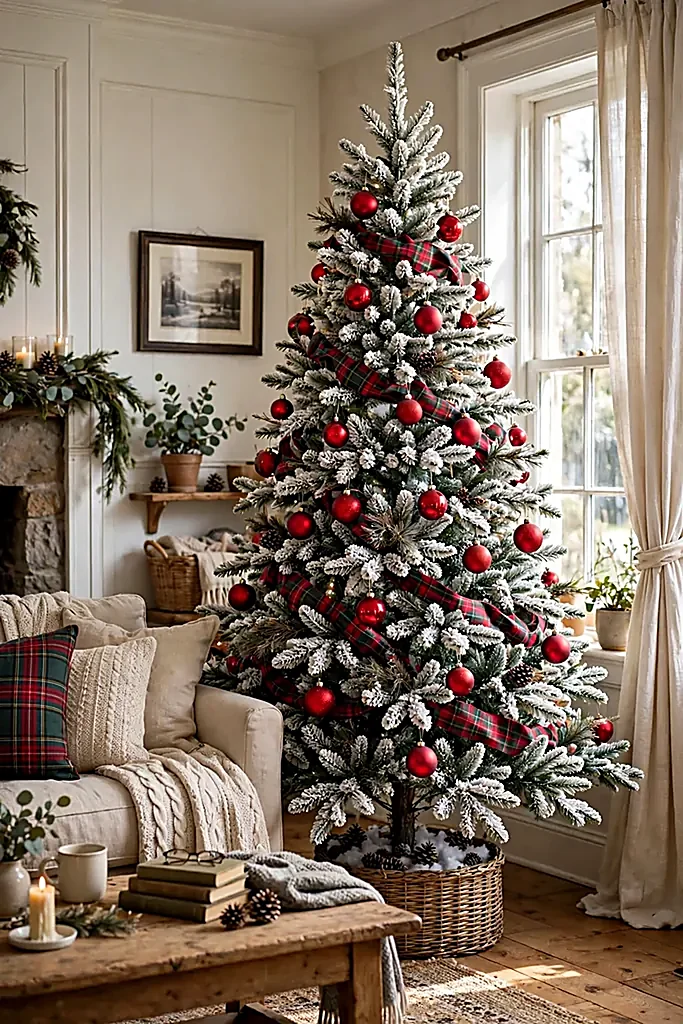
Red is the colour that flocking loves most, because true red holds its depth against white in a way that paler colours cannot. On a snowy tree, a classic red ornament does not need help to be seen, which means you can use fewer, larger red pieces and let the white space between them do the decorating. Tartan adds the traditional layer: a tartan ribbon garland, tartan bows at intervals, or a tartan tree skirt, any one of these is enough, and using all three at once can make the tree look busy against the already-textured flocking. For lights, warm white is again the right call, because it makes red read as rich cranberry rather than bright postbox red, and it keeps the flocking creamy. Hang red ornaments at varied depths, with the largest balls deeper in the tree where the flocking is thickest, so they anchor the colour, and smaller red berries and bows near the tips for detail. If you use a tartan ribbon, cut it wide and drape it in long, vertical swags rather than wrapping it tightly around the tree, since tight wrapping compresses the flocked branches and hides the snow.
A tartan skirt is the easiest way to carry this look to the floor, and it hides the stand while echoing the ribbon above.
Keep the topper simple, a red bow, a gold star, or a tartan bow, so the tree does not end in a clash of patterns. This is the most forgiving flocked-tree scheme for a busy family room, because red and tartan read as Christmas from the doorway, and a few ornaments knocked slightly out of place by small hands barely show against the snow.
Tartan on the tree begs for tartan on the table — these friendsgiving table settings include a plaid setting that matches branch for branch.
Red and Tartan on Flocking at a Glance
| Element | Flocked-tree choice | Why it works |
|---|---|---|
| Red ornaments | Fewer, larger balls, deep inside the branches | Red holds its depth against white, so less is more |
| Tartan | One tartan element only: ribbon, bows, or skirt | Avoids a busy clash with the textured flocking |
| Ribbon draping | Wide ribbon in long, vertical swags | Tight wrapping compresses flocked branches and hides snow |
| Lights | Warm white, nested deep in the branches | Keeps red rich and flocking creamy, not stark |
6. A Slim Flocked Pencil Tree for Small Spaces
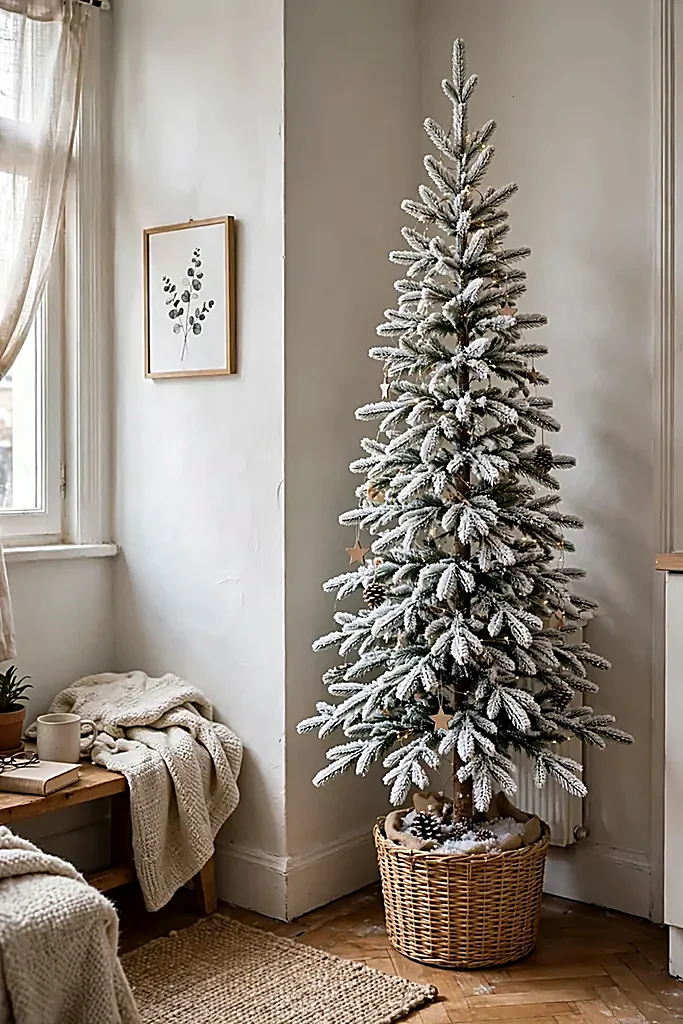
A slim pencil tree is the small-space answer to flocking, because its narrow silhouette brings snow into a corner, a hallway, or beside a fireplace without swallowing the room. The flocking actually helps here: a slim tree can look sparse when it is green, but flocked branches look full even when they are narrow, since the white fills out the shape.
Choose a pencil tree with a medium flocking rather than a heavy one, because heavy flocking on short, slim branches can look top-heavy and shed more in a tight spot where it gets brushed past.
Decorating a pencil tree is a lesson in restraint. Use smaller ornaments than you would on a full tree, and fewer of them, hung close to the trunk rather than dangling from the tips, which stick out sideways on a slim profile and catch on passing coats and bags. Skip a wide garland entirely; a slim tree has no room for one, and a bead garland or a thin ribbon spiralled gently down the tree gives movement without bulk. Lights should be a single strand of small warm white lights, wound close to the trunk so the glow reads as one slim column of light.
Place the pencil tree in a corner with a wall behind it, so the flocking shows against a solid background, and use a small basket or a compact skirt that fits the narrow base rather than a full-size skirt that pools and trips people. A slim tree also suits a second-tree role, in a bedroom or entryway, where its snow reads beautifully in a small space. Fluff the branches by pulling the tips outward and slightly downward, which widens the silhouette just enough to hold ornaments without widening the footprint.
Small spaces are this tree’s whole brief — these christmas decor ideas include a small-space look that still feels full.
Slim Flocked Tree Rules for Small Spaces
- Choose medium flocking; heavy flocking can look top-heavy on short, slim branches.
- Use smaller ornaments hung close to the trunk, not dangling from the tips.
- Skip wide garlands; a thin bead garland or slim ribbon gives movement without bulk.
- Wind one strand of small warm white lights close to the trunk for a column of glow.
7. Champagne and Cream Elegance on Flocked Branches

Champagne and cream on a flocked tree is the most delicate scheme in this list, and the one where flocking density matters most. On a lightly flocked tree, champagne ornaments pick up the green underneath and read as warm gold; on a heavily flocked tree, the same ornaments can disappear into the white unless you give them help. That help comes from texture and shine: mix champagne glass, cream velvet ornaments, and a few metallic gold pieces, so the eye has something to catch even when the colours are close to the branches. Warm white lights are essential here, and they should be plentiful, because champagne and cream have no depth of their own to fall back on. Place lights at two depths, a strand deep inside and a strand nearer the tips, so the tree glows evenly rather than having bright spots and dim patches. A cream ribbon garland, in satin or velvet, adds the one large-scale element this palette needs; drape it in soft, wide swags and let it catch the light, since the ribbon will be doing much of the visual work that bolder colours do in other schemes.
Finish with a cream faux-fur skirt and a gold or champagne topper, and keep the surrounding room calm, cream cushions, warm wood, soft lamplight, so the tree is not competing with bright colours nearby. This tree photographs beautifully and suits a formal living room or a dining room, where its quiet elegance can be appreciated up close. If the tree starts to look washed out from across the room, add a handful of deeper gold ornaments deep inside the branches; they will not change the palette, but they will give it backbone.
Champagne and cream belongs on the table too — these christmas table decorations include an ivory-and-gold setting made for this tree.
Keeping Champagne Visible on White Flocking
Texture and light
- Mix textures: champagne glass, cream velvet, and metallic gold, so the eye has shine to catch.
- Run lights at two depths, deep inside and near the tips, for an even glow.
Ribbon and rescue
- Use a wide cream satin or velvet ribbon in soft swags as the large-scale element.
- If the tree washes out from afar, add deeper gold ornaments deep inside for backbone.
8. Rustic Flocked Tree with Wooden Ornaments and Dried Orange Slices
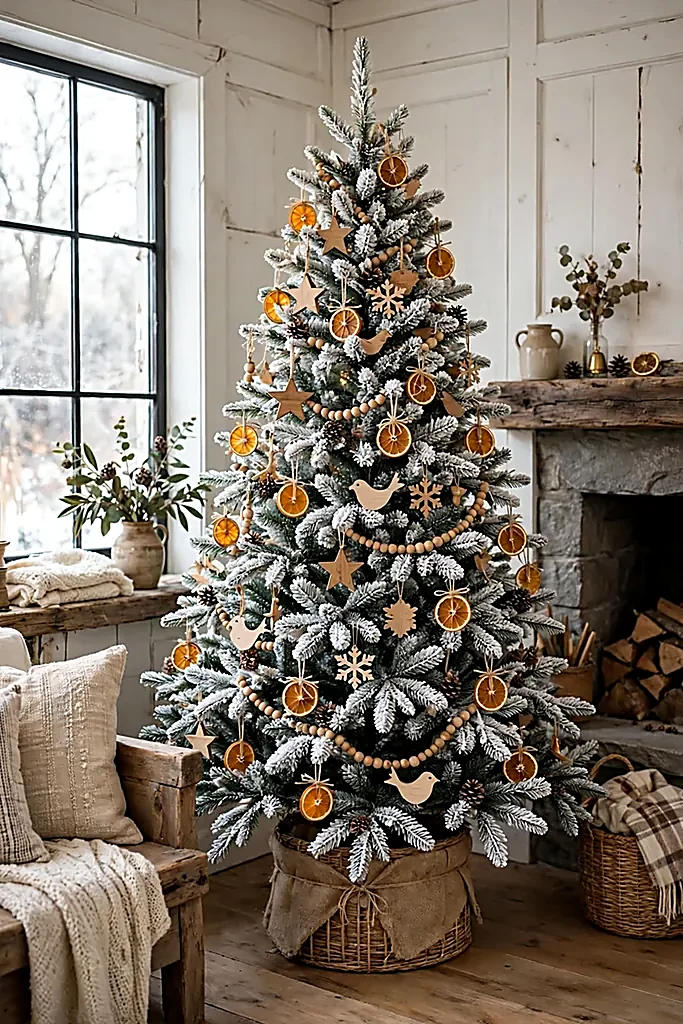
Wooden ornaments and dried orange slices are a natural pair on a flocked tree, because the warm wood tones and the amber orange both stand out against white without needing any glitter or shine. The orange slices do something special here: held up to the lights, they glow translucent amber, like little windows in the snow, and they bring a scent that no plastic ornament can match. Slice oranges thin, dry them slowly until they are crisp, and hang them with twine loops rather than hooks, so they sit flat against the branches instead of spinning.
Wooden ornaments should be simple shapes, stars, trees, hearts, houses, in natural or lightly whitewashed wood, and large enough to read against the flocking. Painted wooden ornaments in muted red or green also work, but keep the painting matte, since glossy paint looks out of place next to matte snow. Hang the wooden pieces on the inner branches where they are supported, and the orange slices nearer the tips and near the lights, where their translucency shows best. A twine garland, or no garland at all, suits this tree; the ornaments themselves provide the rhythm.
At the base, a woven basket collar or a burlap skirt keeps the rustic feeling, and a simple wooden star topper finishes the tree without introducing a new material.
One practical note: dried orange slices attract moisture if the room is very humid, so check them once a week and replace any that soften. This tree suits a kitchen, a farmhouse living room, or any home where Christmas smells as much as it looks, and it pairs beautifully with a real fire and a pot of something spiced on the stove.
Rustic Flocked Tree: Dried Orange Tips
Slice oranges thin and dry them until fully crisp, so they hang flat and last the season, and hang the slices with twine loops near the lights, where they glow translucent amber. Keep wooden ornaments matte and simple, since glossy paint clashes with matte flocking, and check slices weekly in humid rooms, replacing any that soften.
The same collected, lived-in feeling works across the whole room — these vintage home decor ideas show how to mix old pieces with new ones without the room feeling like a museum.
9. Jewel Tones That Pop Against White Flocking

If there is one scheme that proves flocking is not just for pale palettes, it is jewel tones. Emerald, sapphire, ruby, and amethyst all explode against white branches, because the white acts like a gallery wall, giving each saturated colour room to shine. This is the scheme to choose if your flocked tree has ever looked washed out, or if you love colour and worry that a snowy tree will mute it. It will not; it will amplify it, as long as you choose deep, true jewel tones rather than bright, neon versions, which can look garish next to soft snow. The discipline in a jewel-toned tree is to pick two or three jewel colours, not all of them, and repeat those colours through the tree in a balanced way. Emerald and ruby with gold accents is a classic pairing; sapphire and amethyst with silver is cooler and more modern. Use the darkest jewel tone deepest in the branches, where the flocking is thickest, and the brighter jewel tones nearer the tips, so the tree has depth rather than a flat ring of colour on the surface. A jewel-toned ribbon, if you use one, should be a single colour, not a mix, to keep the scheme grounded.
Warm white lights keep jewel tones rich, while cool white lights can make ruby look pink and emerald look teal, so stay warm here too.
At the base, a deep green or burgundy velvet skirt echoes the jewel palette without adding a new colour, and a gold topper ties the metallic accent together. This tree suits a room with deep-coloured furnishings or a dark accent wall, where the white flocking provides a bright focal point and the jewel tones connect the tree to the room around it.
Jewel tones popping against white is a glamour trick anywhere — these halloween nail designs use the same rich-on-pale contrast in miniature.
Jewel Tones on Flocking: Colour Discipline
- Colour count: Pick two or three jewel tones only, and repeat them evenly through the tree.
- Depth order: Place the darkest jewel tone deepest in the branches and brighter tones near the tips.
- Tone quality: Choose deep, true jewel tones over neon brights, which look garish against soft snow.
- Lights: Use warm white lights so ruby stays ruby and emerald stays emerald.
10. Vintage Mercury Glass and Soft Pastels on Flocking

Mercury glass has a mottled, silvery finish that was made for flocked branches, because its aged, cloudy surface echoes the matte texture of the snow instead of fighting it. Vintage-style mercury glass ornaments in soft pastel tints, pale pink, mint, powder blue, and champagne, sit beautifully on white flocking, where their gentle colour and soft shine read as old-fashioned and collected rather than new and plastic. Mix genuine vintage pieces with good reproductions, but keep the finishes consistent: all mercury glass, rather than a mix of mercury and bright shiny glass, which would break the antique mood.
Because pastels are light, the same clustering rule from the blush tree applies here: group ornaments in threes at different depths so the colour builds up and reads from across the room. Mercury glass is heavier than plastic, so hang these ornaments on sturdy inner branches and use short hangers, since long strings let heavy glass swing and knock against neighbouring branches, chipping the finish and shaking flocking loose. Warm white lights placed deep inside the tree will reflect softly in the mercury glass without creating harsh glare. A cream lace or linen skirt suits this tree, and a vintage-style angel or star topper in mercury glass finishes the look. Avoid tinsel entirely here; it would shatter the soft, aged feeling. This tree belongs in a room with vintage touches, old furniture, framed photographs, a well-worn rug, where its collected-over-time feeling makes sense. If you only have a few mercury glass pieces, use them as the stars of the tree, placed at eye level and near the lights, and fill the rest with plain pastel glass in matching tints.
Vintage glass pairs with other hand-touched pieces — a snowflake or runner from these crochet patterns for beginners keeps the heirloom mood.
Mercury Glass and Pastels on Flocking at a Glance
| Element | Vintage choice | Flocking note |
|---|---|---|
| Ornaments | Mercury glass in pale pink, mint, powder blue, champagne | Mottled finish echoes matte flocking instead of fighting it |
| Placement | Clusters of three at different depths, short hangers | Heavy glass needs inner branches; long strings shake flocking loose |
| Lights | Warm white, deep inside the branches | Soft reflection in mercury glass, no harsh glare |
| Avoid | Tinsel and bright shiny glass mixed in | Both break the soft, aged, collected mood |
11. Bold Black and White on a Flocked Tree
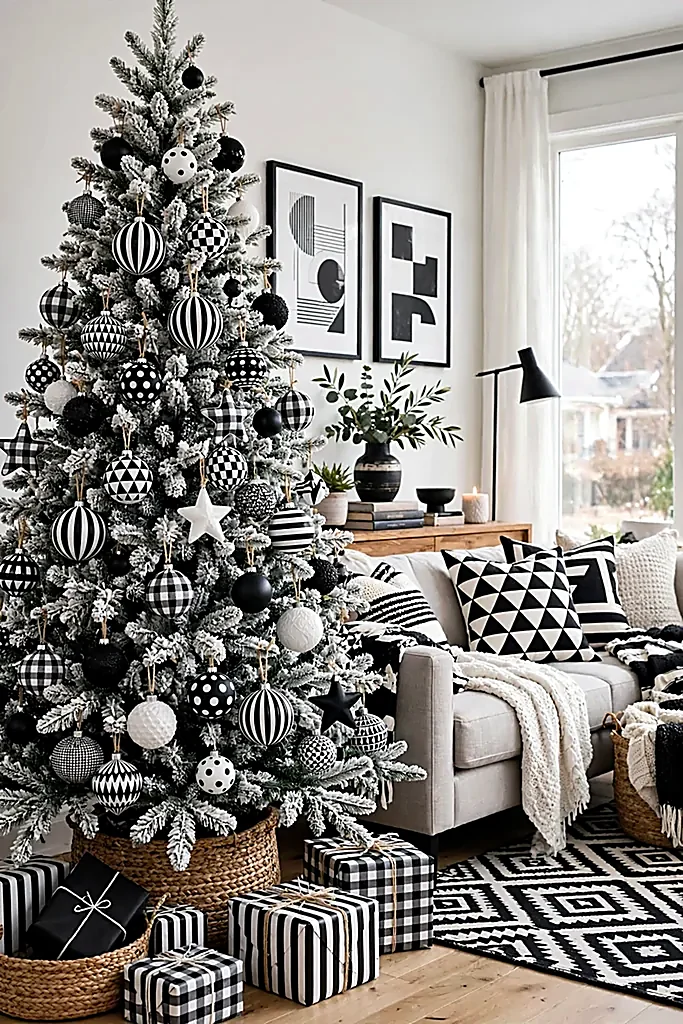
Black and white on a flocked tree sounds stark, but in practice it is one of the most striking schemes you can build, because the white flocking becomes part of the palette instead of just a background. Black ornaments, black ribbon, and black-and-white patterned pieces all pop against the snow with a graphic clarity that no other colour combination achieves. The key is to use black as an accent, not as half the tree: roughly one black element for every three white or silver elements, so the tree reads as snowy with bold punctuation, not as a black tree with snow on it.
Matte black ornaments work better than glossy black here, because matte black sits comfortably next to matte flocking, while glossy black can look like holes in the tree. Mix matte black balls with white ornaments, silver accents, and one black-and-white pattern, striped ribbon, checked bows, or monochrome ornaments, repeated sparingly.
A wide black velvet ribbon draped in loose swags is the single most effective element in this scheme, because it draws the eye around the tree in long, elegant lines and gives the black a sense of movement.
Warm white lights soften the contrast just enough to keep the tree from looking harsh, and a white or black-and-white skirt finishes the base. This tree suits a modern room, a monochrome interior, or a home where Christmas decor usually feels too busy; its discipline is its charm. If the tree starts to feel too severe, add a handful of silver ornaments near the lights, which will sparkle and lift the whole scheme without introducing a new colour.
Black and white confidence is not just for trees — this guide to dressing bold after 50 brings the same graphic boldness to getting dressed.
Black and White Balance on a Snowy Tree
- Use roughly one black element for every three white or silver elements.
- Choose matte black over glossy black, which can read as holes against matte flocking.
- Repeat one black-and-white pattern only, striped ribbon or checked bows, sparingly.
- Soften the contrast with warm white lights and a few silver accents near the lights.
12. Copper and Terracotta Warmth on Snow-Dusted Branches
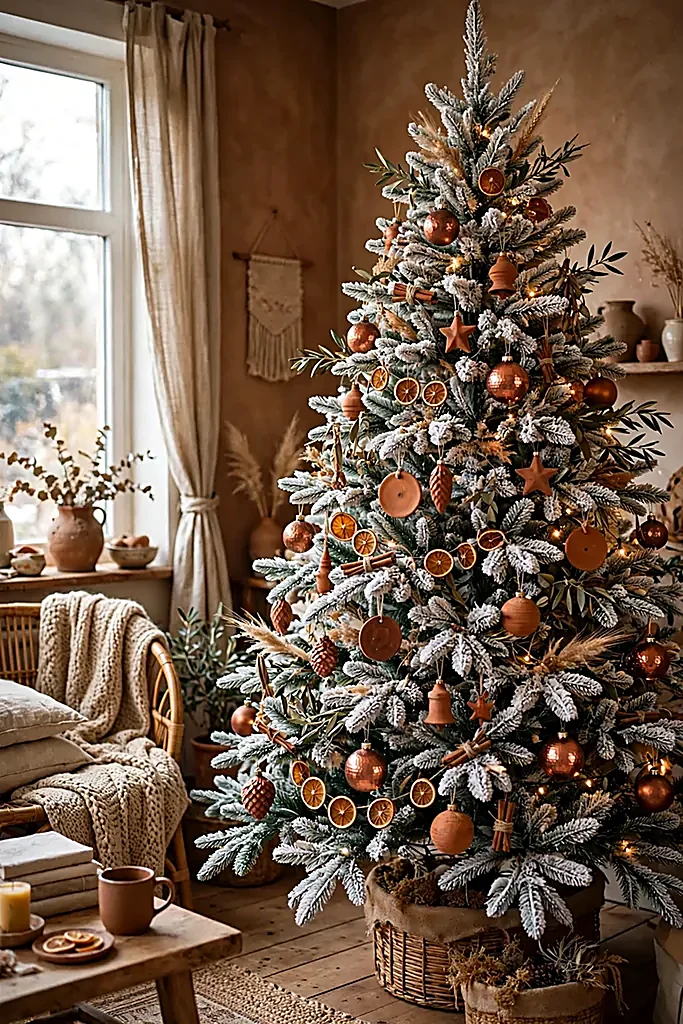
Copper and terracotta bring a warm, earthy glow to a flocked tree that feels like late afternoon sun on snow. Copper is a softer metallic than gold or silver, and against white flocking it reads as warm rather than flashy, while terracotta, in ornaments, ribbon, or dried flowers, adds a clay-rich depth that keeps the copper from looking too metallic.
Together they make a tree that feels both festive and grounded, a good choice for a room with warm wood, leather, or terracotta tiles.
Place copper ornaments near the lights, where their metallic surface catches the warm glow and throws it back across the flocking, and use terracotta pieces, small clay ornaments, dried flowers in rust tones, or terracotta ribbon, deeper in the tree, where their matte texture contrasts with the copper shine. A copper bead garland works well on flocking because it is fine enough not to bury the snow, while a wide terracotta ribbon in loose swags gives the tree its warm colour blocks. Avoid mixing copper with gold here; the two warm metals compete, and copper loses. At the base, a natural linen or woven skirt in a warm neutral lets the copper and terracotta do the talking, and a copper star topper finishes the tree in the same metal. In the room, candlelight in copper or amber glass holders echoes the tree and extends its warmth into the evening. This is a tree that looks best when the room lights are low and the tree lights are the main glow, so dim the overheads and let the copper shine.
Copper and Terracotta Pairing Rules
Placement
- Place copper near the lights so it catches and reflects the warm glow across the flocking.
- Use terracotta deeper in the tree, where its matte texture contrasts with copper shine.
Garlands and metals
- Keep the garland fine, copper beads, or wide and loose, terracotta ribbon, never both bulky.
- Do not mix copper with gold; the two warm metals compete and copper loses.
Warm metallics are also an easy way to make an entryway feel welcoming — if your flocked tree stands near the front of the house, these hallway table decor ideas pair well with the copper-and-terracotta palette.
Frequently Asked Questions About Flocked Tree Decorating Ideas
Let the Snow Do the Talking
Whichever of these twelve flocked looks sounds most like your home, remember that the tree itself is already doing the hardest work. The snow is there before you hang a single ornament, so you do not need to fill every branch or chase a perfect, catalogue look. Choose a palette that holds against the white, nest your warm lights deep inside the branches, hang your ornaments where they can be seen, and step back often to check the whole tree rather than one branch at a time.
Then, when the lights are on and the room is dim, sit down and enjoy it. A flocked tree at its best does not look decorated so much as discovered, as if snow fell on it overnight and someone simply added a little colour and light. That is the magic to aim for: a tree that feels wintry, warm, and a little bit enchanted, all season long.
More from The Glossy Guide
 Fashion and Beauty
11 Holiday Party Outfits That Feel Festive Without Trying Too Hard
December fills up fast: the office party, a friend's open house, dinner at your sister's, a New Year's Eve gathering…
 Fashion and Beauty
12 Scarf Outfits That Turn One Accessory Into the Whole Look
A scarf is the hardest-working piece in any wardrobe. It costs less than a coat, takes up almost no room…
 Fashion and Beauty
13 Winter Fashion Outfits That Make Cold Days Look Effortlessly Chic
Cold weather is not a reason to hide under shapeless layers. With the right coat, a good knit and boots…